Vin Motors · · 9 min read
BMW vs Mercedes vs Porsche (2026): costs, reliability, verdict
Which is more expensive to buy and run: BMW, Mercedes or Porsche? Running costs, reliability, resale value and a clear 2026 verdict.
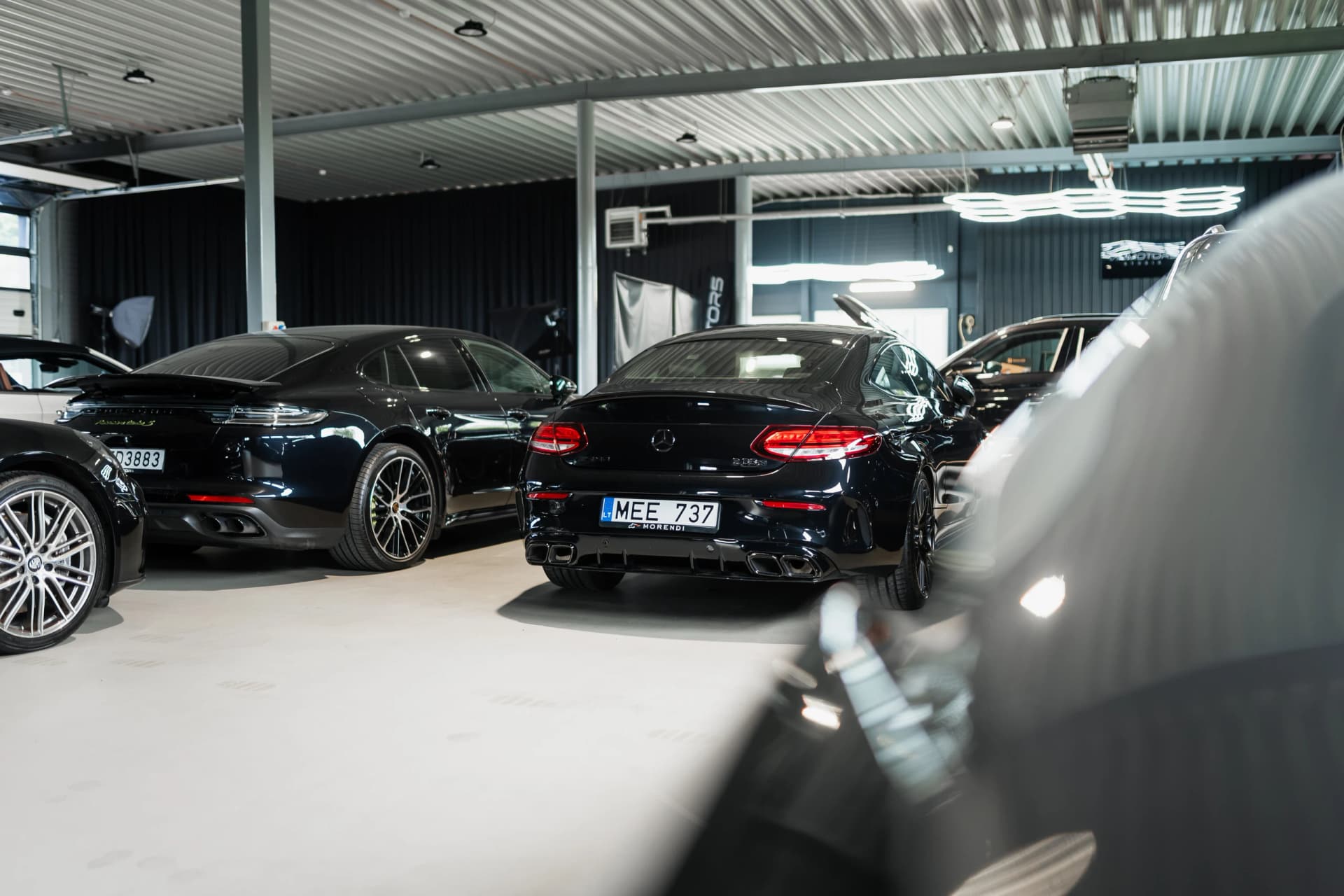
Three brands dominate the Lithuanian luxury car market: BMW, Mercedes-Benz and Porsche. Buyers who walk into VinMotors usually weigh between these three and ask the same question: which one to pick?
There is no single answer. Each has its own character, strengths and weaknesses. A driver who loves adrenaline will never pick a Mercedes over a BMW. Another, who values comfort on long highway runs, will never pick a BMW over a Mercedes. This guide walks through the essence of all three brands so you can figure out which one fits your specific need.
Quick verdict (2026)
Short on time? Here are the direct answers. The details follow in the sections below.
| BMW | Mercedes-Benz | Porsche | |
|---|---|---|---|
| Used price in Lithuania | from ~€25,000 (3-series), M models from ~€60,000 | from ~€25,000 (C-class), AMG from ~€60,000 | from ~€35,000 (Cayenne 3.0), 911 from ~€100,000 |
| Annual running costs | mid-tier premium | mid-tier, similar to BMW | roughly 30-50% higher than BMW or Mercedes |
| Value retention | variable: M-series and X5 hold well, standard models depreciate faster | solid, especially S-class and G-class | best of the three: Cayenne and Macan keep 50-60% after 5 years |
| Best suited for | driving enjoyment and dynamics | comfort, status, family | premium without compromise, investment |
Which is the most expensive? Porsche - both to buy and to run: running costs are roughly 30-50% higher than BMW or Mercedes, and parts are the priciest of the three.
Which is the cheapest to run? BMW and Mercedes-Benz cost about the same - mid-tier premium running costs and a broad base of independent workshops and parts in Lithuania.
Which holds its value best? Porsche: the 911 and Cayenne lead (Cayenne and Macan keep 50-60% of the purchase price after 5 years). Mercedes S-class and G-class and the BMW M-series also hold up well.
Prices are indicative and depend on model, year and condition. In Lithuania all three have a strong secondary market and reliable parts availability through VinMotors and other dealers.
Contents
- Quick verdict (2026)
- Driving feel
- Reliability
- Running costs
- Value retention
- The Lithuanian market
- What to pick by use case
- Vin Motors experience
- FAQ
- Which one is yours?
Driving feel
BMW
BMW builds cars around "Freude am Fahren" (joy of driving). It shows in every detail. The steering is sensitive, slightly heavier than competitors, and very communicative. Dynamic driving is core BMW DNA.
Typical BMW strengths behind the wheel:
- Clear steering feel, real road contact
- Sporty engine note (especially M-series)
- Suspension that holds the car flat in corners
- Quick gearbox response
Weaknesses: BMW sometimes sacrifices comfort for dynamics. Winter conditions with mediocre tyres can be demanding. Standard suspension can feel too firm on long trips.
Mercedes-Benz
Mercedes' philosophy is the opposite: comfort first, dynamics second. Driving a Mercedes after a BMW feels softer, more isolated, "floating". A plus for those who value comfort, a minus for those who want to feel the road.
Typical Mercedes strengths behind the wheel:
- Best cabin noise insulation of the three
- Suspension that handles bumps beautifully
- Long-distance driving is barely tiring
- Premium S-class models genuinely feel like limousines
Weaknesses: Mercedes feels less "alive" than BMW. Sharper steering, faster cornering responses, that's BMW territory. Mercedes wins where what matters is how the passenger feels, not how you control the car.
Porsche
Porsche sits in its own class. It's an engineer's car, where every detail reflects the racing heritage. Driving is more than feel - it's an introduction.
Typical Porsche strengths behind the wheel:
- Precise, immediate steering feel
- Suspension balance between comfort and dynamics
- Engine note (especially petrol 911 and Cayenne GTS)
- PDK gearbox response is the benchmark
Weaknesses: Porsche demands not just good driving but real investment. Standard servicing is more expensive than BMW or Mercedes. Interior space and boot capacity are often smaller than competitors (Cayenne is a partial exception).
Reliability
All three are good, but each has its own characteristic problems:
BMW typical issues
- Cooling system - water pumps and thermostats can fail after 80,000-120,000 km
- VANOS system - oil-level sensors, control electronics
- Gearbox electronics - particularly DKG models
- iDrive screen and software - can be flaky
An average well-serviced BMW can do 250,000+ km. BMWs imported by VinMotors usually come with a full German service history, which significantly reduces the risk.
Mercedes typical issues
- Air suspension (S-class, GLE) - air bags can fail after 150,000 km
- AdBlue system on diesel models - sensor problems
- Electrical contact issues - especially on pre-2018 models
- Boot tailgate motor - mechanical failures
Mercedes generally lasts longer than BMW, but when something breaks, the repair is more expensive. AMG models have their own specific quirks (engine insulation, suspension).
Porsche typical issues
- Cayenne and Macan turbo engines - oil consumption after 100,000 km
- PCCB ceramic brakes - replacement costs several thousand euros
- PDK gearbox - reliable, but repair needs a Porsche specialist
- Air suspension - similar issues to Mercedes
Porsche brakes and suspension are extremely durable. But when parts need replacing, they're the most expensive of the three.
Running costs
Approximate annual running costs for premium SUVs (BMW X5, Mercedes GLE, Porsche Cayenne):
| Item | BMW X5 | Mercedes GLE | Porsche Cayenne |
|---|---|---|---|
| Standard service | Mid | Mid | High |
| Tyres (set of 4) | Mid | Mid | High (larger sizes) |
| Brake set replacement | Mid | Mid | Very high |
| Insurance (full coverage) | Mid | Mid | Higher |
| Fuel (mixed cycle) | Mid | Mid | Higher |
Numbers are indicative. Specific amounts depend on model, trim, and use. But the trend is clear: Porsche running costs are roughly 30-50% higher than BMW or Mercedes.
Parts: BMW and Mercedes have many independent suppliers in Lithuania. Porsche parts are usually special-ordered, which extends repair times.
Value retention
Typical 5-year depreciation:
- Porsche - holds value best. Classic 911 sometimes appreciates. Cayenne and Macan after 5 years are still worth 50-60% of purchase price.
- Mercedes - solid value retention, especially S-class and G-class. Mid-range models (C-class, E-class) track market average.
- BMW - more variable. M-series and X5 hold well. Standard 3 and 5 series depreciate faster.
This aspect is often overlooked at purchase but is the most important financial consideration. A Porsche bought and sold after 3-5 years often costs less than a cheaper-bought but faster-depreciating model.
The Lithuanian market
All three brands are well represented:
- BMW - widest selection. Almost every model is available via German imports. VinMotors regularly imports BMW vehicles.
- Mercedes-Benz - second most popular, especially C-class, E-class, and GLE. The Mercedes-Benz inventory is broader than BMW in some niches.
- Porsche - smaller selection but high quality models. The Porsche inventory concentrates on Cayenne, Macan, and 911.
All three sell well on the secondary market. That matters if you plan to buy and eventually sell rather than keep forever.
What to pick by use case
Daily commute + comfort
Mercedes-Benz (E-class or GLE). Best insulation, smoothest suspension, least tiring on long drives.
Driving enjoyment + dynamics
BMW (M-series, M3, M5, X5 M50i). Best road feel, sporty character.
Premium status + business car
Mercedes S-class or Porsche Cayenne. Both signal status, both have excellent interiors.
Family + space
Mercedes GLE or BMW X5. Three rows of seats (if needed), spacious boot, strong safety equipment.
Investment (value retention)
Porsche (911, limited-edition models). Best value retention, smallest 5-year loss.
First premium car
BMW 3-series or Mercedes C-class. Most accessible entry models, broad parts ecosystem, gentle introduction to the premium world.
Vin Motors experience
VinMotors specializes in all three brands. We work with BMW, Mercedes-Benz, and Porsche imports from Germany every day. Our car sourcing to order service is tailored to luxury-car specifics.
Our inventory:
- BMW vehicles - X5, X7, M-series, 5 and 7 series
- Mercedes-Benz vehicles - GLE, S-class, E-class, AMG models
- Porsche vehicles - Cayenne, Macan, 911
If you're considering your first premium purchase or looking to swap your current car, send a request for a car to order or call +370 662 76235. We can help you figure out which brand fits your needs, budget, and use case.
We also frequently help clients sell their existing car via commission sales while we import a new one from Germany.
FAQ
Which brand has the lowest running costs?
BMW and Mercedes are similar - mid-tier premium running costs. Porsche is roughly 30-50% more expensive. Specific figures depend on the model (M3 costs more than 320d, AMG GLE 63 more than GLE 350d).
Which brand is best for Lithuanian winters?
All three handle winter well with proper tyres. Subjectively: Mercedes 4MATIC and BMW xDrive systems are very similar. Porsche ePOWER (Cayenne, Macan) gives excellent stability.
Is a diesel still worth it?
The diesel market is shrinking, especially in Western Europe. But in Lithuania diesel is still economical for long trips. BMW xDrive 30d, Mercedes GLE 350d, Porsche Cayenne 3.0 Diesel are all good choices. With new EU regulations, this segment depreciates faster though.
How much money do I need to start?
Entry models (3-series, C-class, Cayenne 3.0) start around €25,000-35,000. Premium S-class or M3/AMG models start at €60,000-80,000. Top tier (911, S 580, X7 M50i) starts at €100,000+.
Which brand is best for resale?
Porsche, especially 911 and Cayenne, holds value best. Mercedes S-class and G-class are also strong. BMW M-series holds well; standard models depreciate faster.
How can I tell I'm buying a good example?
Three keywords: full service history, VIN history check, professional inspection. The same principle applies to all three. That's why, when we source a car to order, we check its VIN history (Carfax/AutoDNA) and condition before purchase. An on-site inspection, for example by TÜV or DEKRA, is available as an extra.
Which one is yours?
The final decision is often emotional. You'll pick the one that feels "right" behind the wheel. But this guide should help you start the consideration with the right expectations.
If you'd like to test a specific model or have questions about which brand fits your needs, browse our current inventory or contact us. We work personally with each client - not just selling, but helping you make the right choice.